Absolics Announces 400 Billion KRW Rights Issue… Secures Funds for Glass Substrate Commercialization

• Raises 401.1 billion KRW via shareholder allotment... preemptively secures funds required for the commercialization of glass substrates.

• Enters reliability evaluation for 'Embedding' products... prepares to launch Proof of Concept (PoC) for 'Non-Embedding' products within the year.

• Prioritizes new shares based on existing shareholders' equity ratios... in the event of forfeited shares, additional subscriptions by existing shareholders and third parties will be carried out.


Absolics, SKC’s glass substrate investment company, is initiating a rights issue worth approximately 400 billion KRW. SKC announced on the 21st that Absolics has decided on a shareholder-allotted rights issue to secure the financial resources necessary for the commercialization of glass substrates.


Absolics plans to focus the secured funds on glass substrate evaluation and client certification. Alongside this, the company will pursue upgrades to certain facilities and equipment to improve yield and enhance quality across the entire production process.


Building on this foundation, Absolics plans to accelerate its "two-track" strategy, simultaneously pursuing the commercialization of both "Embedding" and "Non-Embedding" products. The Embedding products have successfully completed preliminary evaluations—including the verification of electrical properties for samples produced at its Georgia plant in the U.S.—and have now entered the reliability evaluation phase. The Non-Embedding products are also part of a project scheduled for supplier selection in the second half of this year, and the company is preparing to initiate a Proof of Concept (PoC) within the year depending on the final selection results.


Moving forward, Absolics intends to continue making additional investments in alignment with client evaluation results and phased milestones. The immediate focus will be on stably achieving the quality levels demanded by clients, after which it plans to further review plans for large-scale expansion investments.


An SKC official stated, "Through this preemptive financing, we will drive the commercialization of Absolics' glass substrates without any setbacks and further accelerate our mass production preparations." They added, "Based on close collaboration with our strategic partners, we will continue to solidify our overwhelming technological leadership in the next-generation semiconductor packaging market."


Meanwhile, Absolics is currently owned 70.05% by SKC and 29.95% by AMAT (Applied Materials). The acquisition of new shares will proceed according to the internal procedures of each shareholder. In the event of forfeited shares, they will be allocated through additional subscriptions by existing shareholders and third parties based on the inter-shareholder agreement. [End]


2026-08-21
SKC Posts Consecutive Quarters of Positive EBITDA... Continues Earnings Recovery

●​ EBITDA surges threefold QoQ to KRW 29.1 billion... Financial structure improved following the completion of a paid-in capital increase​

●​ Chemical business leads earnings recovery with a 218% spike in operating profit... Driven by a focus on high-value-added products

●​ Copper foil business achieves record quarterly sales & Semiconductor materials business shows solid growth... Tangible results in the glass substrate business​


SKC (CEO Kim Jong-woo) announced on the 27th that it recorded KRW 645.4 billion in sales and KRW 14.4 billion in operating loss for the second quarter of this year.


Sales increased by approximately 30% compared to the previous quarter, and the operating loss narrowed by about 50%. EBITDA (Earnings Before Interest, Taxes, Depreciation, and Amortization), a key indicator of cash-generating capability, expanded roughly threefold quarter-on-quarter to KRW 29.1 billion, marking the second consecutive quarter in the black. Furthermore, by successfully completing a paid-in capital increase of KRW 1.1647 trillion, the company significantly improved its net borrowings and debt-to-equity ratio.


The profitability recovery of the chemical business played a major role in this quarter's performance. The chemical division posted KRW 317.8 billion in sales and KRW 30.5 billion in operating profit, a 218% jump from the previous quarter. Although production and sales volumes declined due to global supply chain uncertainties, rising prices of PG (Propylene Glycol) and PO (Propylene Oxide) drove up revenue. In addition, expanded sales of high-value-added products, combined with intensive cost-reduction efforts and process efficiency improvements initiated early this year, led to maximized profitability.


The copper foil business achieved record-high quarterly sales of KRW 254 billion. With the sales proportion in North America expanding to 67%, the sales volume of copper foil for ESS (Energy Storage Systems) and EVs (Electric Vehicles) increased by 76% and 28%, respectively, driving growth. In the second half of the year, the company plans to further enhance its cost-competitiveness by fully operationalizing its Malaysia-centric production and sales system.


The semiconductor materials business recorded sales of KRW 72.9 billion and an operating profit of KRW 21.3 billion. Sales of test sockets for AI data centers surged 66% year-on-year, continuing its growth trajectory, and solid profitability was maintained through expanded sales of high-value-added products. For the second half, the company aims to actively respond to growing customer demand by expanding production capacity backed by the expansion of its Plant 1 in Vietnam.


The glass substrate business accelerated its "two-track" strategy to commercialize both embedding and non-embedding products simultaneously. Initial reliability tests for embedding products have commenced, and the company has embarked on a new project by supplying non-embedding prototypes for next-generation network semiconductors to a U.S. telecommunications company. In the second half, the glass substrate division plans to successfully conclude the reliability tests for embedding products and ensure seamless preparation for the Proof of Concept (POC) for non-embedding products.


An SKC official stated, "In the second quarter, we were able to lay the foundation for earnings recovery as profitability improved across all businesses and achievements in new businesses materialized." The official added, "In the second half, we will continue to improve profitability by enhancing operational efficiency, while solidifying our mid-to-long-term growth foundation by strengthening the technological competitiveness of our new businesses." [End]

2026-07-27
SKC Publishes ‘2026 Sustainability Report’

​● ​Strengthened materiality assessment by expanding stakeholder participation and survey scope… Derived three core issues

​● ​Includes achievements in strengthening the ESG competitiveness of investee companies, such as expanded data disclosure for ISC and ‘Copper Mark’ certification for SK nexilis

​● ​Introduced an AI-utilized risk review process… Enhanced the overall completeness of the report


SKC (CEO Jong-woo Kim) announced that it has published its '2026 Sustainability Report,' detailing the company's ESG (Environmental, Social, and Governance) management activities and performance, on its official website. SKC has been publishing a sustainability report annually since 2020 to engage in transparent communication with various domestic and international stakeholders.


In this year's report, SKC incorporated an advanced double materiality assessment system to identify the company's key ESG issues. Notably, the company expanded the participation of internal and external stakeholders, including outside directors, to conduct an in-depth analysis of the environmental, social, and financial impacts of its ESG issues. Through this process, SKC derived three core issues: △ Climate change response, △ Strengthening industrial safety and health, and △ Reducing waste and pollutants.


Furthermore, as part of its efforts to strengthen company-wide ESG data management, SKC significantly expanded the scope of environmental and social data disclosure for ISC, its semiconductor test solution investee company. In particular, the company conducted a physical risk analysis regarding climate change, which allowed it to proactively identify the potential financial impacts the climate crisis could have on each business site, thereby elevating its systematic, company-wide risk management capabilities.


The report also highlights activities aimed at enhancing the ESG competitiveness of each investee company. A key example presented is SK nexilis, SKC's copper foil business investee, which became the first in the battery industry to acquire the ESG certification 'Copper Mark,' gaining global recognition for its high standards in supply chain management.


In addition, the report comprehensively covers greenhouse gas emission data management performance aimed at achieving Net Zero by 2040, efforts to create a work environment that supports the voluntary growth of employees, and corporate social responsibility (CSR) activities designed to foster the sustainable growth of local communities. Moreover, the preparation of this year's report incorporated a risk review process utilizing an internal AI system, which further improved the report's quality and accuracy.


An SKC official stated, "For this year's report, we focused on enhancing transparency and reliability by further upgrading our company-wide ESG data management and diagnostic systems. We will thoroughly internalize ESG not merely as a declaration but as a core management system, creating substantial change through clear goals and responsible execution."


The full text of the SKC 2026 Sustainability Report is available on the company's official website. [End]​

2026-07-01
SKC Accelerates Company-Wide AI Transformation... Launches Dedicated Organization and Establishes AI Utilization System

​● Establishes 'AI Frontier TF,' a dedicated organization directly reporting to the CEO... Promotes integrated AX across SKC and its investment companies

● Creates an environment for AI utilization... Reviews the introduction of enterprise generative AI solutions

● Conducts customized AI training by rank, from executives to employees... Fosters in-house AI experts


SKC (CEO Kim Jong-woo) is accelerating its AI Transformation (AX). SKC announced on the 26th that it has launched a dedicated organization to promote AX and is setting out to establish a company-wide AI utilization system.


First, early this year, SKC established the ‘AI Frontier Task Force (TF),’ a dedicated organization directly under the CEO that oversees company-wide AX. Officially launched last month, this TF includes members from SKC as well as its investment companies, such as SK Nexilis, SK picglobal, ISC, Absolics, and SK leaveo.


The 'AI Frontier TF' is responsible for discovering and advancing work-related AX initiatives, and it leads the practical implementation of AI by collaborating with external experts. In particular, it plans to establish clear AI utilization guidelines to resolve any difficulties employees may experience during the AI adoption process.


Alongside the operation of this dedicated organization, SKC is also working to create an environment conducive to AI utilization. In addition to the existing internal work-specialized agent, A.Biz, the company plans to review the introduction of enterprise generative AI solutions, such as Enterprise ChatGPT, to build an infrastructure where employees can actively utilize AI in their daily tasks.


AI training for employees will also be strengthened. SKC is expanding the AI utilization training it has conducted since last year into a customized 'AI Leadership' course tailored for executives and team leaders this year. Furthermore, the company plans to foster in-house AI experts by providing action learning opportunities where employees can directly discover and execute AX tasks in their actual work.


An SKC official stated, "AI is already an irreversible trend changing the paradigm of the entire industry, and it has become a core standard determining a company's future competitiveness." The official added, "Through the operation of a dedicated organization, the creation of an AI-friendly environment, and the strengthening of our employees' capabilities, we will accelerate company-wide AX and ensure it leads to tangible, practical results." [End]​

2026-06-26
SK Nexilis Wins U.S. Patent Lawsuit Jury Verdict… All 5 Patent Infringement Claims Upheld

● Jury rules in favor of SK Nexilis in U.S. patent lawsuit against Solus Advanced Materials on the 22nd (local time), confirming patent infringement by the counterparty.

Final judgment expected within weeks; subsequent procedures, including damage assessment, to follow based on the ruling.


SK Nexilis, a copper foil manufacturing investment hand of SKC (CEO Kim Jong-woo), has won a favorable jury verdict in its ongoing patent infringement lawsuit in the United States, officially confirming the infringement of its patents.

SK Nexilis announced that on the 22nd (local time), the jury at the U.S. District Court for the Eastern District of Texas rendered a verdict fully supporting SK Nexilis’s claims on all five subject patents in the lawsuit filed against Solus Advanced Materials (hereinafter "Solus").


The jury found that Solus infringed upon SK Nexilis’s core copper foil patent technologies, which contribute to enhancing battery energy density and charging efficiency. These patents pertain to technologies that stably control the shape and physical properties of products during the copper foil manufacturing process to reduce wrinkling and tearing, and prevent structural damage during charging and discharging, thereby improving battery durability and performance.


With the jury verdict concluded, a final judgment is expected to be handed down within the coming weeks. Following the final ruling, subsequent procedures will be initiated to determine the scale of damages and the scope of royalty payments.


An official from SK Nexilis stated, "This jury verdict marks the first official recognition by a U.S. court that the research and development achievements accumulated by SK Nexilis over decades have been infringed upon without authorization in the actual industrial field. We plan to actively respond to the upcoming final judgment and related subsequent legal proceedings." [ENDS]

2026-05-25
SKC Conducts Cemeteries Cleansing Activity to Honor Fallen Heroes for Memorial Day

● A 19-year tradition since 2008; CEO Jong-woo Kim and key executives join this year’s volunteering

"We will continue to fulfill our corporate social responsibility based on our well-established volunteer culture."


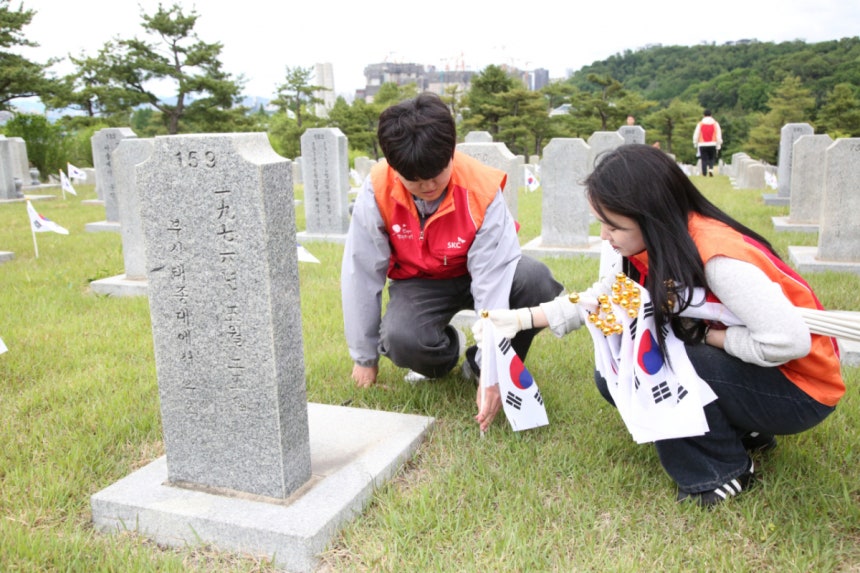
SKC (CEO Jong-woo Kim) announced today that it conducted a cemetery cleansing activity, including placing Korean national flags (Taegeukgi), at the National Cemetery in Seoul to pay tribute to fallen heroes ahead of the 71st Memorial Day.


Key executives, including CEO Jong-woo Kim and CFO Dong-ju Park, visited the site to participate in the activities alongside employees. The volunteer group began by observing a moment of silence at the Memorial Tower for patriotic martyrs and fallen heroes. They then moved to Cemetery No. 19, which honors 913 fallen soldiers and officers, to plant national flags, pull weeds, and wipe down tombstones.


SKC’s cemetery cleansing activity is not a one-off event but part of a deeply rooted corporate volunteer culture. Following the launch of its volunteer group in 2004, SKC established a sisterhood relationship with the Seoul National Cemetery in 2008 and has continued this initiative for 19 consecutive years.


An SKC official stated, "Through this activity, where management and employees came together, we were able to once again honor the sacrifices of our patriotic martyrs. As a responsible company that contributes to the nation and local communities, we will continue to carry out regular social contribution activities moving forward." [ENDS]


2026-05-22
SKC Secures 1.2 Trillion KRW via Rights Offering; Accelerating Glass Substrate Commercialization and Financial Restructuring

• Final offering price set at 99,500 KRW, issuing 11.73 million shares to raise 1.1671 trillion KRW

• Increased proceeds to expand debt repayment; Debt-to-equity ratio projected to drop sharply from 230% to 129%

• Market confidence bolstered by Q1 turnaround and U.S. IR activities; Focus on progress in next-gen glass substrate commercialization


SEOUL, South Korea – SKC (CEO Kim Jong-woo) is set to accelerate investment in its core future business, glass substrates, while significantly improving its financial structure through a rights offering totaling 1.1671 trillion KRW.


On the 12th, SKC announced that the final issuance price for the rights offering was confirmed at 99,500 KRW. Consequently, SKC will issue 11.73 million new shares to raise a total of 1.1671 trillion KRW. The market expects this capital injection to serve as powerful momentum for securing future growth engines and establishing financial stability.


The funds secured through this offering will be strategically utilized for new business investments and strengthening financial soundness. Initially, SKC planned to allocate approximately 590 billion KRW to the glass substrate business and 410 billion KRW to debt repayment. However, as the total proceeds increased due to a rise in stock price, the capacity for debt repayment expanded significantly. Since the investment for glass substrates—set at 589.6 billion KRW—proactively covers the maximum capital required for the next three years, the company plans to use the excess proceeds to increase the scale of debt repayment.


As a result, the improvement in key financial indicators, such as the debt-to-equity ratio, is expected to be maximized. While the ratio was projected to be in the low 140% range if 410 billion KRW were repaid, the increased repayment of 577.5 billion KRW is expected to drastically lower the ratio from approximately 230% at the end of last year to around 129%. This allows the company to preemptively reduce interest expenses amid high-interest rates while simultaneously bolstering internal stability and growth.

The backdrop of this increased funding lies in the recovery of SKC's fundamental competitiveness and proactive communication by management. Despite short-term stock price adjustments in March due to external factors like geopolitical risks in the Middle East, the company signaled a clear performance turnaround in its recent Q1 earnings report, achieving a positive EBITDA of 10 billion KRW for the first time in 10 quarters.


Furthermore, the recent global Investor Relations (IR) tour held for institutional investors in four cities, including New York, proved effective. Led by CEO Kim Jong-woo, the management actively communicated plans for profitability recovery, semiconductor-centered business restructuring, and glass substrate progress, successfully building firm market trust and consensus on the company’s strategic direction.


The progress in commercializing glass substrates by Absolics, an SKC subsidiary, also played a decisive role in the stock price rebound. Absolics recently launched a new project by supplying prototypes of next-generation "non-embedding" glass substrates for network semiconductors to a U.S. telecommunications chipmaker.


Designed to significantly enhance performance in high-frequency and high-density environments compared to conventional substrates, the product is currently showing tangible results in the client's reliability evaluations. If it passes, mass production preparations could begin as early as the end of this year, further raising market expectations.


An SKC official stated, "This result is a testament to the deep resonance among shareholders and investors regarding SKC’s fundamental competitive recovery and the future value of our next-generation glass substrate business. With the secured funds, we will ensure the seamless commercialization of glass substrates and accelerate our 'Stability, Recovery, and Leap' strategy through groundbreaking financial restructuring."


Meanwhile, the subscription for existing shareholders will take place on May 14 and 15, with the new shares scheduled to be listed on June 8. [End]

2026-05-12
SK Nexilis: Consecutive Key Rulings Strengthen Our Position in Ongoing Legal Disputes


l U.S. court opens trade-secret case; upon a finding of misappropriation, it may enjoin manufacture, sale, and distribution

l PTAB denies all five of Solus Advanced Materials’ IPR petitions and the rehearing requests

l Scope of alleged U.S. patent infringement by Solus expands as the court accepts additional key issues for adjudication

l Korean Intellectual Property Trial and Appeal Board invalidates four Solus patents; company declines to appeal


SKC’s affiliate in the copper foil business for EV batteries, SK Nexilis, announced that its trade-secret lawsuit against Solus Advanced Materials (“Solus”), filed in the U.S. District Court for the Eastern District of Texas, was formally opened early last month. The company stated that the court’s decision to proceed indicates that the case warrants full adjudication, and that SK Nexilis will continue to respond proactively as the litigation moves forward.


If misappropriation of trade secrets is found, the court may issue injunctive relief enjoining the manufacture, sale, and distribution of the products at issue. Where willful and malicious misconduct is established, the U.S. Defend Trade Secrets Act (DTSA) permits enhanced damages of up to three, times the compensatory amount.


Alongside the opening of the trade-secret case, developments in the United States have trended favorably for SK Nexilis regarding questions about Solus’s technological credibility. All five inter partes review (IPR) petitions that Solus filed with the U.S. Patent Trial and Appeal Board (PTAB) seeking to invalidate SK Nexilis’s patents were denied at the pre-institution stage. Solus’s rehearing requests were also ultimately denied, concluding the matter in SK Nexilis’s favor.


At the pretrial conference held in October, additional key issues related to Solus’s alleged patent infringement were highlighted. The court set all of SK Nexilis’s points for adjudication at trial, including:

Rebuttal to Solus’s claim of “independent R&D,” alleging that former employees from SK Nexilis’s predecessor entity were involved, raising concerns about potential technology misappropriation; and

Allegations that Solus submitted only selectively favorable samples as evidence


The court also ruled that Solus may not rely at trial on technology-development claims predicated on patents held by Circuit Foil Luxembourg (CFL), a subsidiary that Solus recently agreed to sell to a Chinese company. SK Nexilis stated that this ruling meaningfully signals the court’s willingness to question the reliability of Solus’s technical assertions and the propriety of its evidentiary submissions.


Regarding the U.S. court’s recent decision to admit CFL product samples into evidence, SK Nexilis stated that the materials are not persuasive enough to establish patent invalidity and are unlikely to affect the substantive outcome. The company had previously moved to exclude the samples on the grounds that they were improperly submitted.


Developments in Korea have also continued to favor SK Nexilis. The Korean Intellectual Property Trial and Appeal Board (KIPTAB) invalidated four of the eight Solus patents that SK Nexilis challenged, and Solus did not appeal, making the decisions final last month. Industry observers view this as an indication that Solus may have concluded that maintaining its defense for these patents would be difficult. Patent-infringement lawsuits in Korea based on the invalidated patents are also expected to be dismissed.


The remaining four patents are still under review at KIPTAB, and SK Nexilis believes the likelihood of invalidation is high given the presence of prior art for all of them. Notably, two of these patents were confirmed to have been acquired by Solus from a Japanese company shortly before Solus filed suit.


An SK Nexilis spokesperson commented, “Although the litigation is still ongoing, the results from various proceedings in the United States and Korea show that Solus’s arguments are unlikely to gain traction. We will continue to substantiate the facts and work to ensure that our rights are properly protected throughout the remaining process.”

2025-12-03
SKC CEO & President Woncheol Park reported business performance in front of 100,000 SKC shareholders via live online streaming.

● SKC’s 50th Ordinary General Meeting of Shareholders was held on March 28, strengthening shareholder communication through CEO presentation and live online streaming.

The original bills were passed, including the appointment of Eunmi Chae and Jeongin Kim as outside directors. SKC will continue to reinforce the Board of Directors and enhance shareholder value.


SKC (CEO & President Woncheol Park) held its 50th Ordinary General Meeting of Shareholders (AGM) on Floor 6 of its headquarters at Jongno-gu, Seoul, on the morning of March 28. 


This year, for the first time in its history, SKC live-streamed the General Meeting of Shareholders online, significantly improving shareholder accessibility. As the chair of the AGM, SKC CEO & President Woncheol Park personally delivered a presentation to shareholders, reporting on last year’s performance and this year’s business principles. He also answered shareholders’ questions submitted online in advance.


“We secured approximately KRW 1.6 trillion financial resources for growth after selling the film business and continued to expand the EV battery materials business as we completed Jeongeup Plant 5 and started building a plant in Poland,” said CEO & President Park about SKC’s business performance last year. He further explained, “We also pursued new businesses in semiconductors and eco-friendly materials by becoming the world’s first to commercialize DPG-only process and starting the construction of production facilities for semiconductor glass substrates.” SKC’s last year’s performance included solid ESG achievements, such as establishing a roadmap to promote 2040 Greenhouse Gas Net Zero.


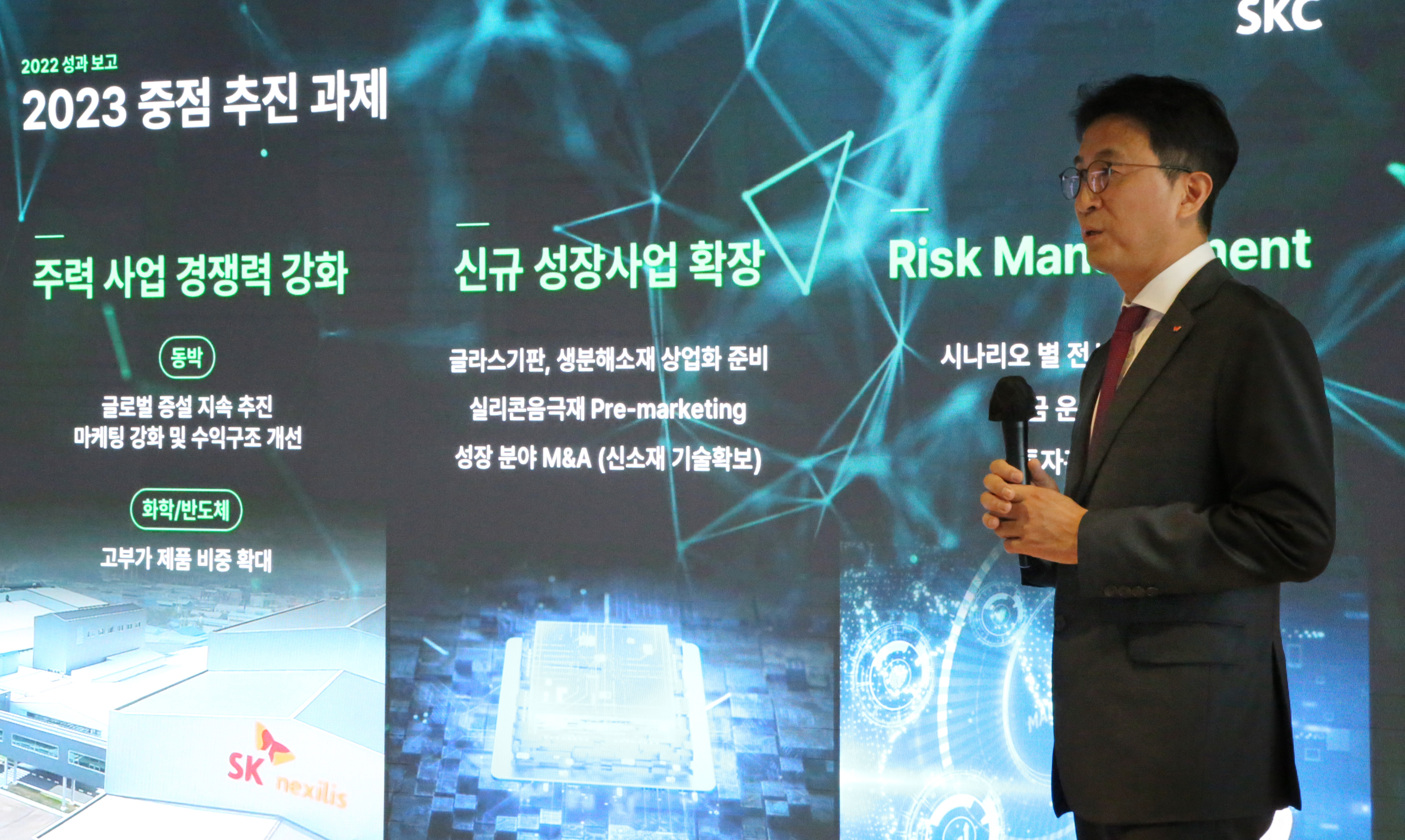
As for this year’s business principles, CEO & President Park emphasized, “We will achieve our vision of becoming a global ESG materials solution provider that offers differentiated products and solutions through global expansion and super-gap technological edge in areas including EV batteries, semiconductors, and eco-friendly materials.” On the same day, SKC announced that 2023 key focus areas selected to achieve its vision of becoming a global ESG materials solution provider are enhancing the competitiveness of its main businesses, expanding new growth businesses, and risk management precision.


CEO & President Park said, “This year, we plan to enhance the competitiveness of our main business areas through global expansion and augmented sales of copper foil business and by increasing the proportion of high value-added products in semiconductors and chemicals businesses,” and added, “In addition to commercializing glass substrates, biodegradable materials, and silicon anodes, we will expand new growth businesses through further mergers and acquisitions (M&A).” He also explained that the company would seek enhanced business stability with scenario-based risk management.


At the AGM, multiple bills were passed to appoint Eunmi Chae as an outside director and Audit Committee commissioner, Jeongin Kim as an outside director, Junsik Chae as a non-executive director, and Siwon Park as an Audit Committee commissioner. With the appointment of director Eun-mi Choi, who previously worked for a global enterprise, SKC increased the proportion of women among outside directors to 50%. Director Jeong-in Kim is a start-up founder who is a hard-to-find member on the boards of conglomerates with expertise in strategy, finance, and M&A.


The original bills to approve the financial statements and directors’ remuneration ceilings were also passed at the AGM. An SKC executive said, “Thanks to shareholders’ support, SKC has strengthened the board’s diversity and expertise while gearing up for business innovation this year. We will do all we can to increase shareholder value further.” [End]


[SKC CEO & President Woncheol Park is reporting this year’s business plans at the 50th Ordinary General Meeting of Shareholders held at SKC headquarters in Jongno-gu, Seoul, on March 28.]


2023-03-28
​"Technology is the Breakthrough"… SKC plants the seeds of technology to raise industrial sustainability.

"Technology is the Breakthrough"…

SKC plants the seeds of technology to raise industrial sustainability


[ESG Showcase 2022] SMEs and joint ventures show growth based on SKC’s Open Platform for New Materials and Startup Plus.


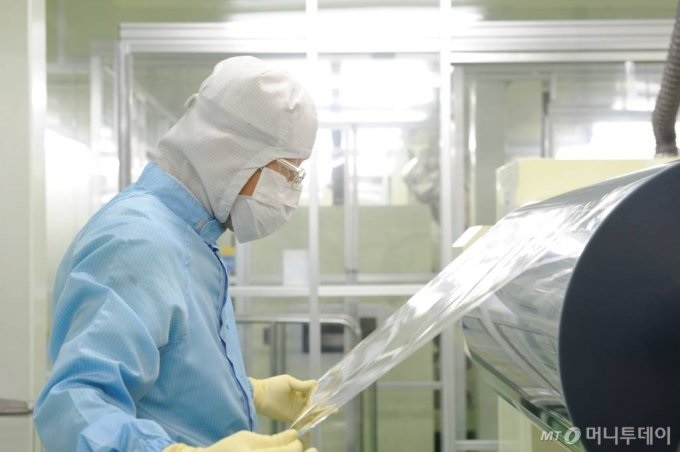
An employee is at the shatter-proof film production line of SKC hi-tech&marketing Cheonan Plant

located at Cheonan-si, Chungcheongnam-do. / Image from SKC


SKC truly represents South Korea as a company specialized in chemical materials used for various fields including the following: rechargeable battery materials such as electric foils for EV, ESS (energy storage system) and other IT devices; chemical materials such as insulators and lubricants for cars, cosmetics and home appliances; and, industrial materials such as optical packaging and other semiconductors.


Starting from the self-development and mass production of polyester film in 1977, SKC continued to make remarkable achievements being the first in South Korea to succeed in the commercial production of PO (propylene oxide) and also being the first in the world to succeed in the commercialization of HPPO, an eco-friendly PO production process using hydrogen peroxide. More recently, the company is preparing to become the first in the world to commercialize glass substrate for low power, high performance semiconductors.


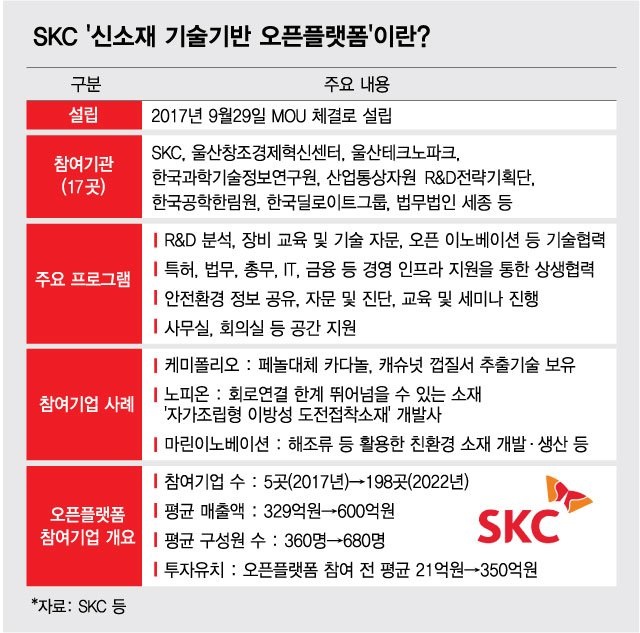
While SKC is now known as a materials company widely acknowledged both at home and abroad, the early days of polyester film development was a time of discouragement due to the cold response from companies that already had related technologies. Building upon the research & development efforts that went on for almost 50 years, SKC has been seeking ways to support joint ventures and startups in the materials industry so that their ideas can be turned into a business. SKC itself has made arrangements to meet numerous organizations to explain its plans to create an open platform and invited their participation. As a result, the Open Platform for New Materials was established on September 2017 through an MOU (memorandum of understanding). The project was joined by 17 specialty organizations including SKC, Korea Institute of Science and Technology, Office Strategic R&D Planning, Deloitte Korea, Korea Technology Finance Corporation and Shin & Kim.


The Open Platform for New Materials (the “Open Platform”) is performing a number of roles including: providing support for commercialization in connection with nationwide projects; matching technologies in demand with companies that need the technologies; providing specialized advice on the engineering and technology fields; offering technology valuation and specialized consulting; and, providing financial and legal advice. It is thus intended by SKC to make a contribution to capability building on sustainable industrial ecosystem management by providing support for technological development of SMEs because this is what SKC is good at.


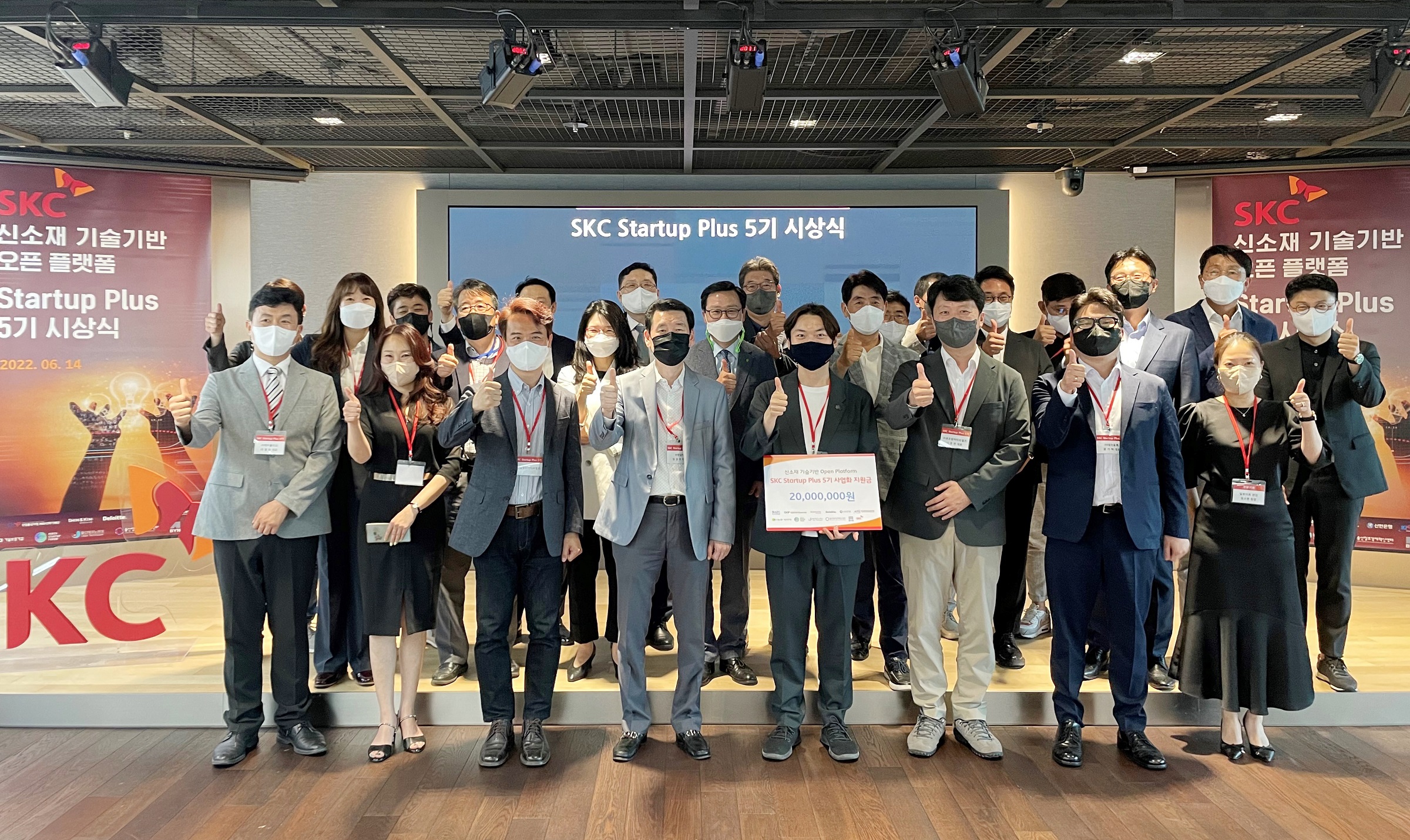
In the early days, the main participants of the Open Platform were joint ventures and startups from Ulsan, the base of SKC’s chemical business. In 2018, however, the SKC Startup Plus contest became open for nationwide competition, inviting more and more joint ventures and startups from all parts of the country to participate in the Open Platform. The participating companies’ business areas were also expanded to the materials field whereas IT was formerly the dominant field. The number of companies selected in the Startup Plus was five at first, ten in 2019 and sixteen in 2020, which was again reduced to five since 2021 in an aim to focus on a small group of companies.


An SKC executive said, "We originally invited high performance and high value companies across the industrial materials sector but, from this year, we have limited the participation to companies that are related to SKC’s key business areas, i.e., mobility, semiconductors and eco-friendly materials," and further explained, "It is because SKC will be able to offer more practical help if the companies are doing business in areas SKC knows well and has the technological expertise.”


This year, five companies were selected as follows: Cuprum Materials, specialized in next-generation materials for 5G 28㎓ communication boards; Killington Materials with an energy-saving production technology of rechargeable battery anode materials; Terra Block which manufactures high purity, recycled materials through plastic waste depolymerization; Chemaltech which is engaged in the development of non-phosphorus corroding materials for 3D NAND flash; and, 119 REO which specializes in firefighter suit upcycling. It is notable in particular that 119 REO was the first company to be selected as a soon-to-be social enterprise. Some other major companies that gained attention in the Open Platform and Startup Plus include: Chemifolio with technology to extract Cardanol, 100% eco-friendly material from cashew nut shell; Nopion which has developed a self-assembly anisotropic conductive adhesive that can overcome the limitations of ever-miniaturizing circuit interconnection; and, Marine Innovation which is an eco-friendly materials development company using marine plants.


A total of 198 companies so far have participated in the Open Platform including the companies selected for Startup Plus. Average sales of these companies have increased from KRW 32.9 billion to KRW 60.0 billion and their average number of employees have also increased to 680, twice the former average of 360. These results show that SMEs, joint ventures and startups can achieve stable growth based on their technological competitive edge.


SKC is also striving to improve supply chain stability by establishing a supply chain that reflects social value such as: support for capability improvement of partner companies; green purchase policy and eco-friendly product buying; ESG risk management of partner companies; and, partner company selection by indexing their social values and reflecting them in the assessment.


In the meanwhile, SKC is attending the ESG Showcase 2022 at Orchid Room, Western Josun Seoul at Sogong-dong, Seoul on July 14 hosted by Money Today and sponsored by Korea Exchange, Korea Financial Investment Association and KBIZ Korea Federation of SMEs. The Showcase’s theme is ‘In Search of Sustainable Industrial Ecosystem Management in South Korea,’ and SKC is presenting efforts that have been focused on providing support for SMEs to improve their capabilities of sustainable industrial ecosystem management.


https://news.mt.co.kr/mtview.php?no=2022071015310163967​


2022-07-11